Hi all,
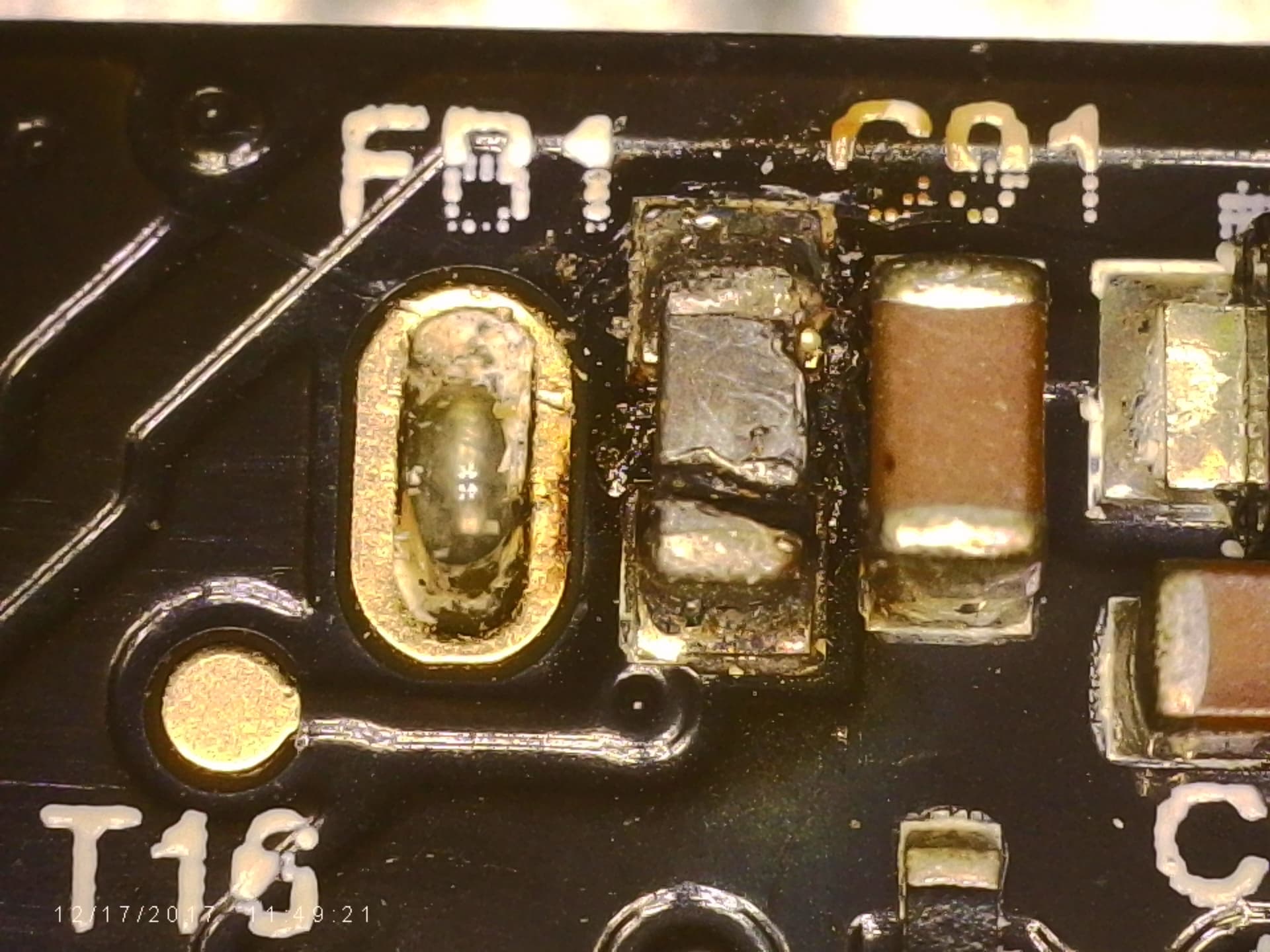
I made the mistake of plugging into my S1 controller without the USB isolator. This blew up the port on my PC and one of the capacitors/resistors that couple the USB C port to the rest of the board. I would like some help determining what capacitor/resistor I blew up so I can try repairing it. The label above the blown component is “FB1”.
I would also like to know how such an explosive result was achieved and why.
Thank you,
Marcus
1 Like
What!? Is there some danger of burning the usb post from the odrive? I thought it was just communication for the purpose of drawing graphs and sending control signals? I see now that this is available, why should it be needed?
What @Emroess experienced is honestly something I’ve never seen before. However, it is strongly recommended to use a USB isolator whenever connecting DC power and USB simultaneously, otherwise you can create a ground loop, which can damage the microcontroller on the ODrive. On ODrive Pro/S1, all other user-facing interfaces have onboard isolators (e.g. UART, STEP/DIR, etc), or are highly tolerant of ground variations (e.g. CAN). However, USB is unfortunately a special case, where it’s very difficult/bulky/expensive to isolate onboard the S1 (look how big that USB isolator is!), and since the majority of applications use CAN or UART for the final system, it doesn’t make sense to have a USB isolator on each drive – it would just balloon board size and cost for the end user.
Normally just a 1:1 ODrive ↔ computer connection won’t have any ground loop issues (since there aren’t multiple paths for ground), but we always recommend using USB isolators since you can easily create them inadvertently (e.g. an Arduino + ODrive both connected to your computer and the same power supply).
But as I mentioned, I’ve literally never seen an issue quite as catastrophic as this one – the only risk (should) be damaging the ODrive’s microcontroller. We’re digging into it on the Discord to see if there’s something else that went on – for that FB1 component to blow up, there would’ve had to be something seriously wrong that put amps of current through the USB 5V input – much more than feasible when powered from USB even with a hard short circuit.
1 Like